

Quick answer: Mashrabiya cutting in Sharjah is the CNC cutting of traditional and modern Islamic lattice patterns into MDF, wood, plywood, acrylic, aluminium or steel to make screens, partitions, window panels, ceiling features, doors and facade cladding. Faisal Javed Group of Companies designs, CNC-cuts, finishes and installs custom mashrabiya from its workshop in Industrial Area, Sharjah, for villas, mosques, hotels, restaurants, offices and developers across Sharjah, Dubai and the UAE.
Few design elements are as closely linked to Sharjah’s heritage as the mashrabiya. In the old houses of the Heart of Sharjah, carved wooden lattice screens once shaded windows, cooled breezes and gave families privacy while letting them look out onto the street. Today the same idea appears in modern villas, mosques, hotel lobbies and building facades across the emirate, now produced with CNC machines for perfect accuracy.
This guide explains what mashrabiya is, how CNC mashrabiya cutting works, the best materials and patterns, where mashrabiya screens are used, how outdoor screens cope with the climate, what affects cost and how to plan a project. Faisal Javed Group produces mashrabiya through its CNC Decor & Signage division.
What Is Mashrabiya?
A mashrabiya is a decorative lattice screen made of repeating geometric or arabesque openings, traditionally used in Arabic and Islamic architecture on windows, balconies and interior partitions. It filters sunlight, allows air to flow and provides privacy, so people inside can see out without being easily seen.
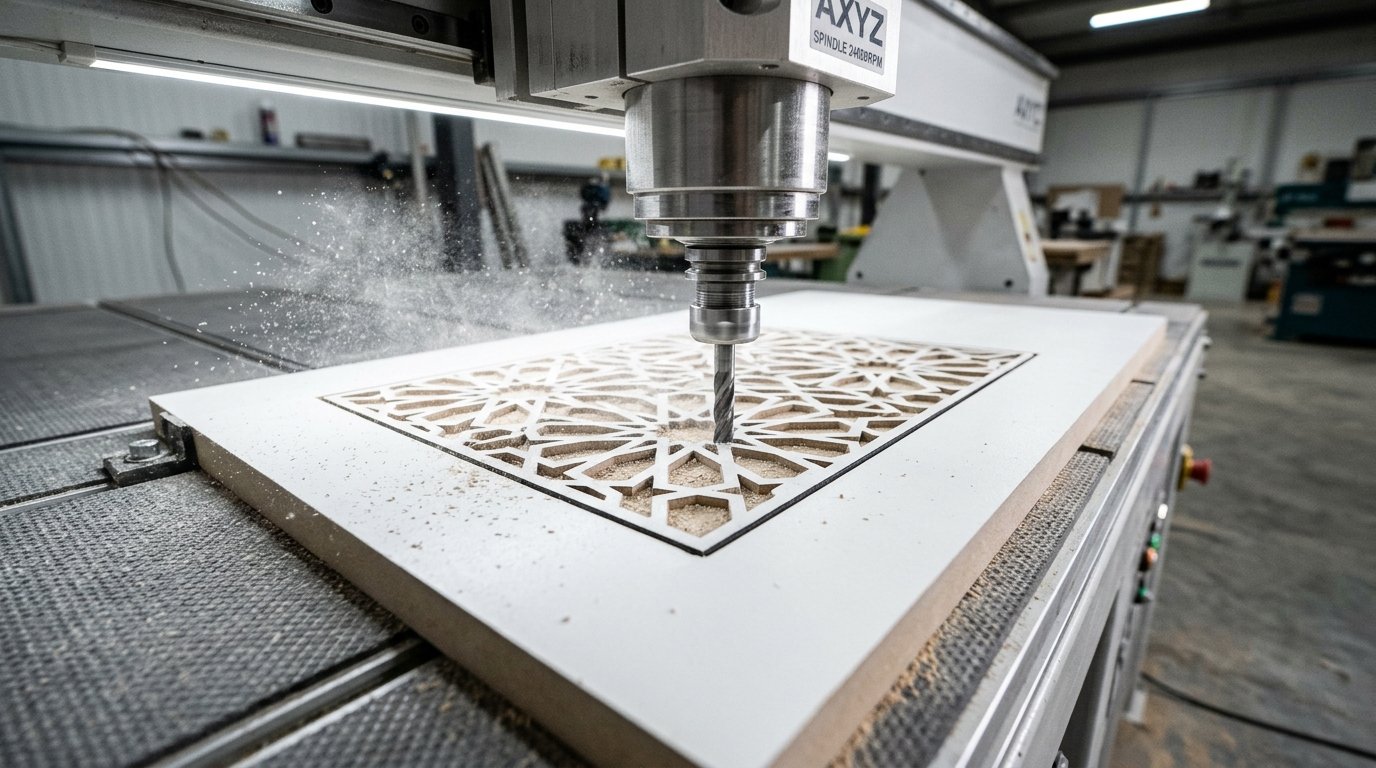
Historically, mashrabiya screens were assembled by hand from small turned wooden pieces. Modern mashrabiya is usually cut from a single sheet using CNC machines, which makes it faster, more affordable and available in almost any size, pattern and material.
How Does CNC Mashrabiya Cutting Work?
- Pattern selection: Choose a traditional star pattern, arabesque, modern geometric design or a custom motif.
- Design to size: The pattern is scaled and arranged to fit the exact opening, with solid borders and fixing points.
- Engineering checks: Bar widths and openings are set to suit the material thickness so the screen stays strong.
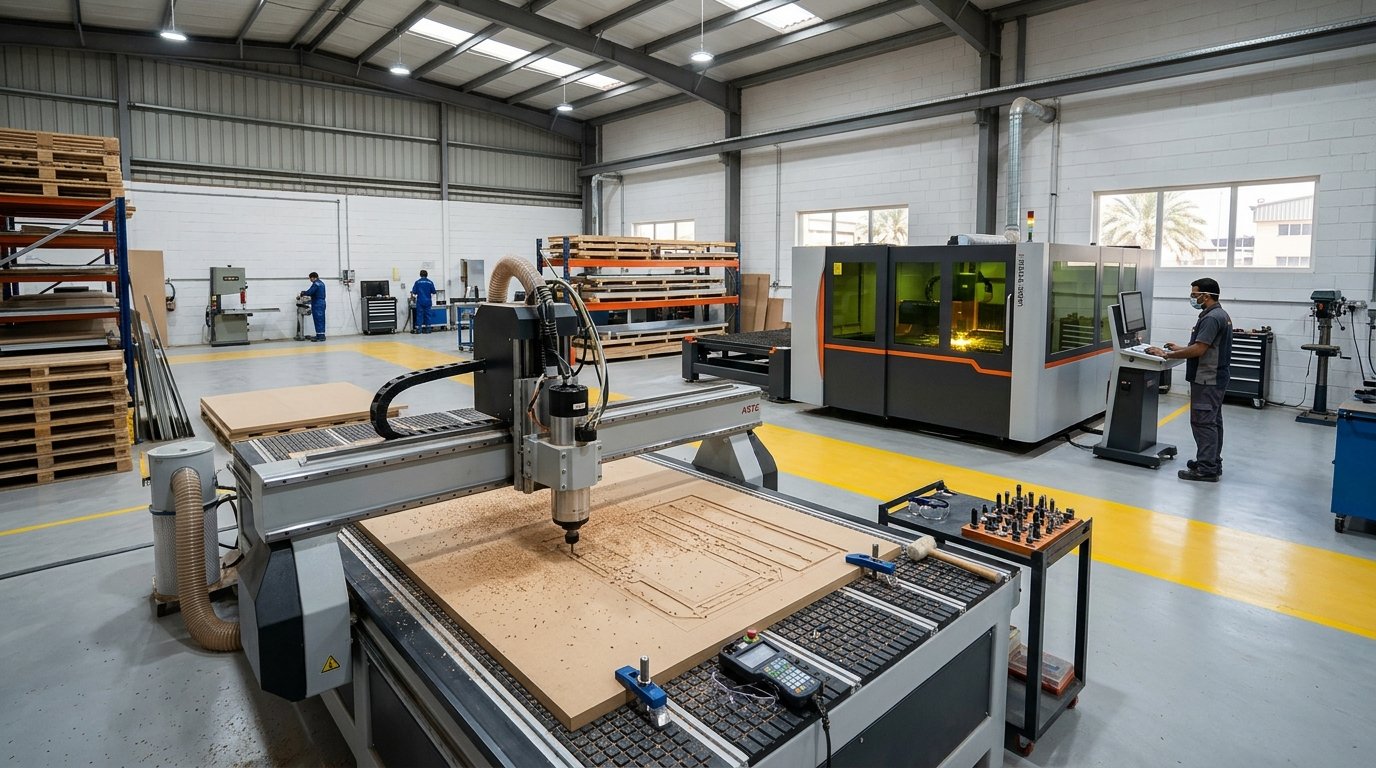
- CNC cutting: A CNC router cuts wood, MDF and acrylic, while a fiber laser cuts metal sheets.
- Finishing: Panels are sanded and painted, stained, lacquered or powder coated.
- Installation: Screens are fixed into frames, walls, ceilings or facade systems, sometimes with LED backlighting.
Which Materials Are Best for Mashrabiya Screens?
MDF is the most popular material for painted indoor mashrabiya, solid wood and veneered plywood give a premium natural look, acrylic suits modern and illuminated designs, and aluminium or powder-coated steel are best for outdoor screens and facades.
| Material | Best for | Indoor / outdoor | Finish options |
|---|---|---|---|
| MDF (standard or moisture-resistant) | Partitions, ceilings, wall panels, cabinet doors | Indoor | Painted any colour, lacquered |
| Solid wood and veneered plywood | Majlis screens, doors, luxury interiors | Indoor | Stained, oiled, lacquered |
| Acrylic | Modern screens, backlit panels, retail displays | Indoor | Coloured, frosted, mirror, gold |
| Aluminium | Facades, balcony screens, large outdoor panels | Outdoor | Powder coated, wood-effect finishes |
| Mild or stainless steel | Gates, fences, boundary screens, feature walls | Both | Powder coated, brushed, gold PVD |
Popular Mashrabiya Patterns
- Eight-point star (khatam): The classic Islamic star pattern, ideal for majlis rooms and mosques.
- Twelve- and sixteen-point stars: More intricate patterns for statement walls and ceilings.
- Arabesque and floral: Flowing, organic designs for softer, decorative interiors.
- Modern geometric: Hexagons, diamonds and simplified lattices for contemporary homes and offices.
- Custom motifs: Patterns built around a family crest, company logo or calligraphy.
Where Is Mashrabiya Used in Sharjah?
Villas and Majlis Rooms
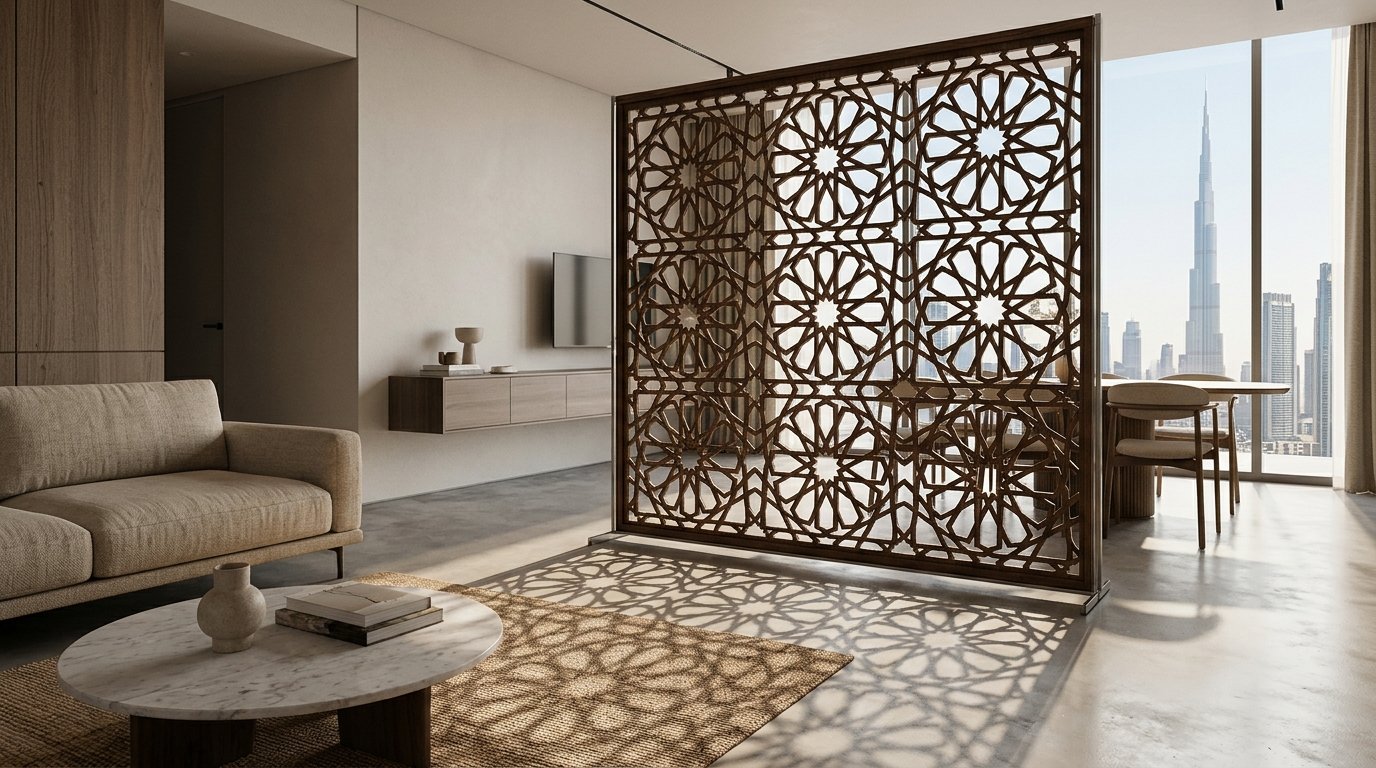
Mashrabiya partitions separate majlis, dining and family areas, while window screens add privacy from neighbours and the street. They are popular in villa communities such as Al Rahmaniya, Al Suyoh, Muwaileh and Al Tay.
Mosques and Prayer Rooms
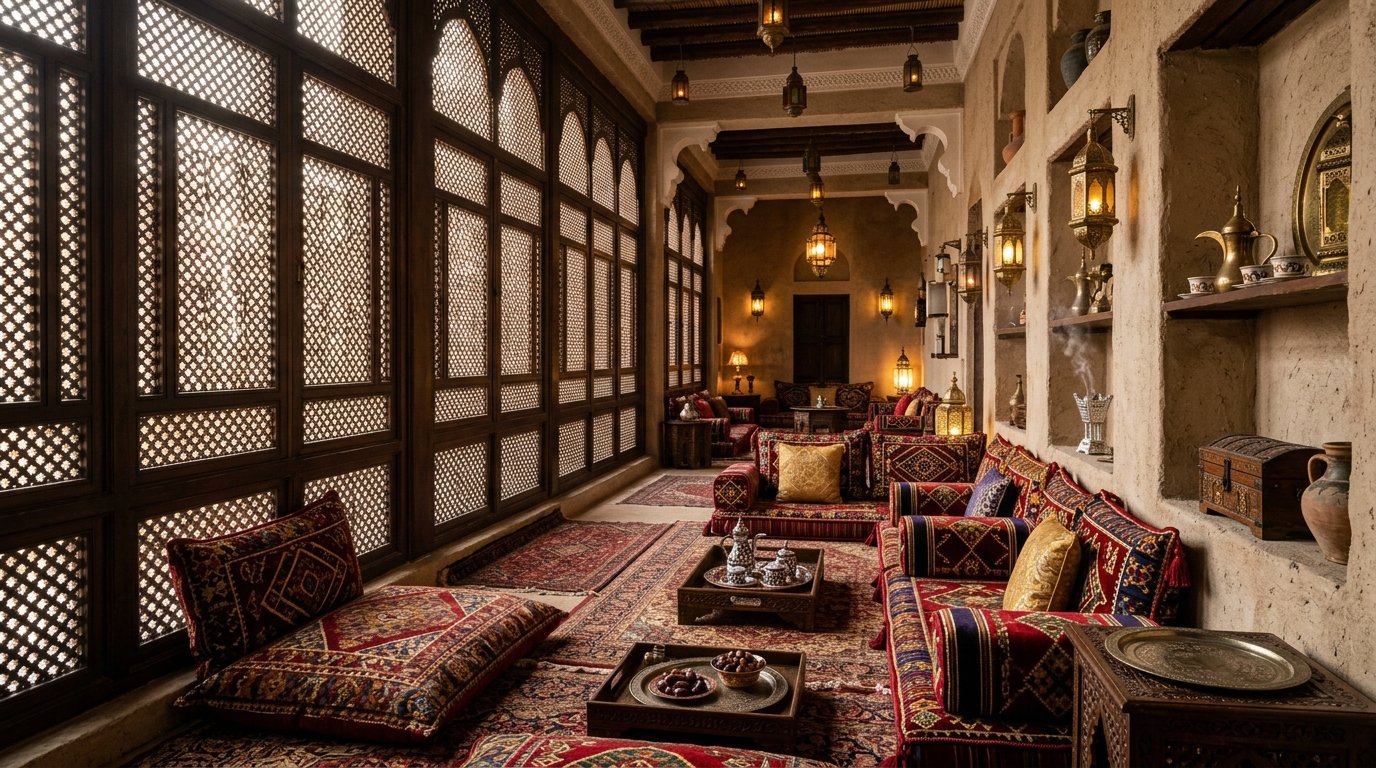
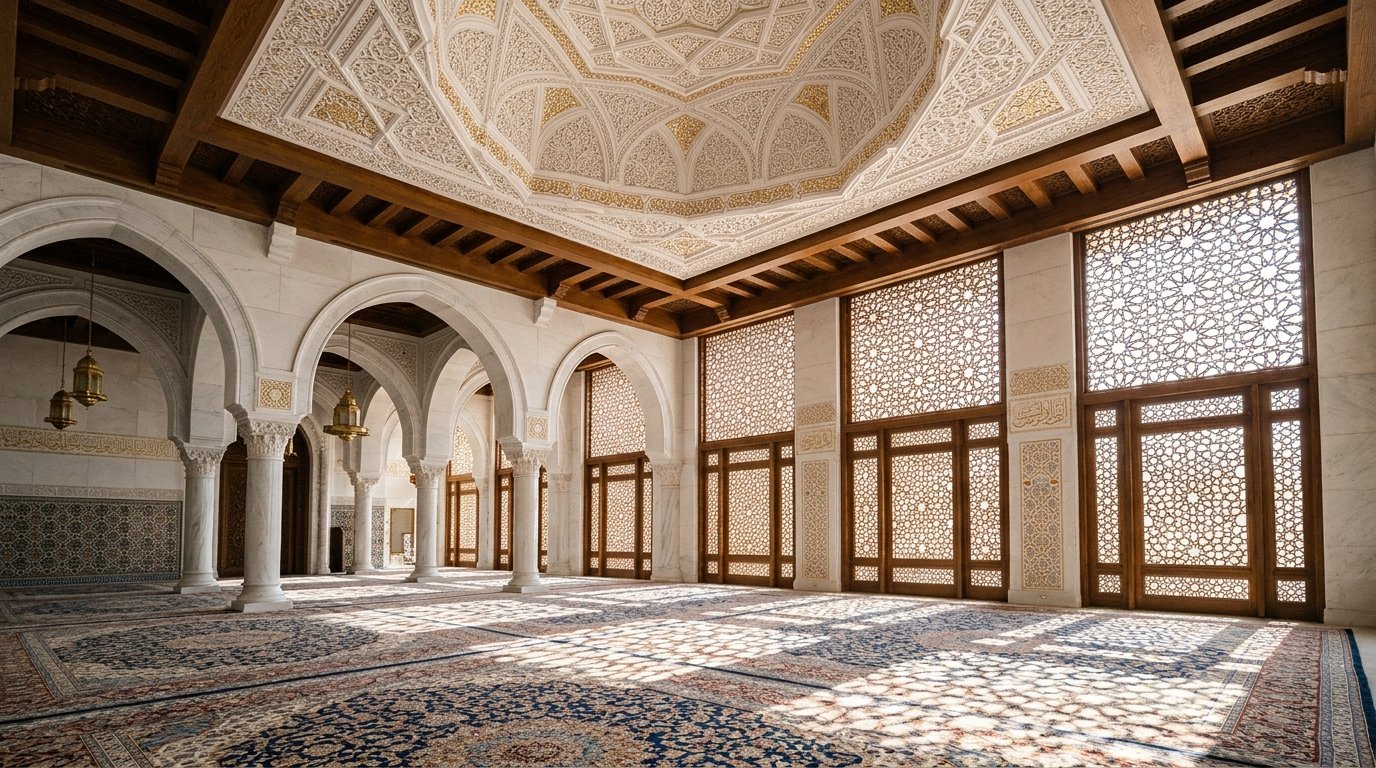
Screens, ceiling panels, women’s prayer area partitions and window grilles bring traditional character and light control to mosques and musallas.
Hotels, Restaurants and Cafes
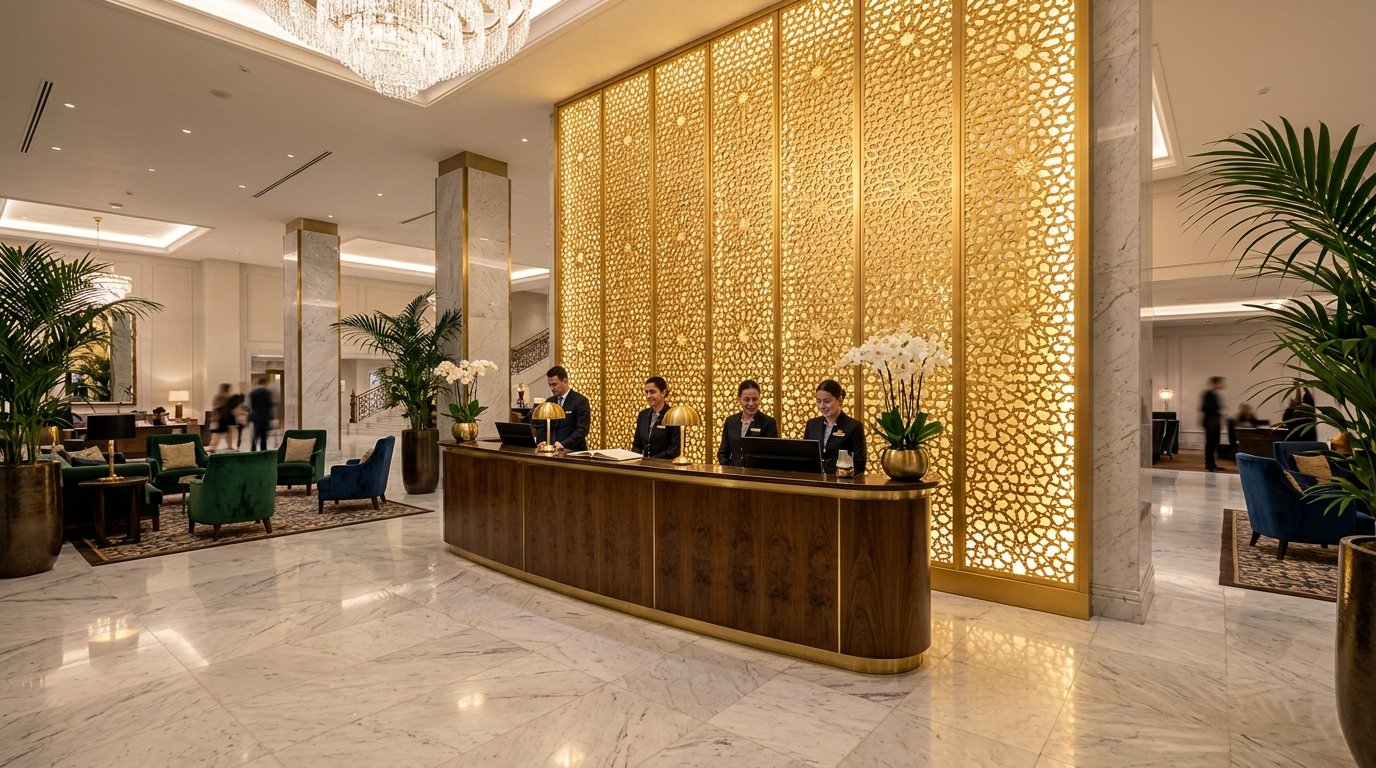
Mashrabiya creates semi-private dining zones, decorative ceilings, reception backdrops and lighting features with a strong sense of place.
Offices and Retail
Branded partitions, reception features and display backdrops use mashrabiya to give modern commercial spaces a regional identity.
Facades, Balconies and Boundary Walls
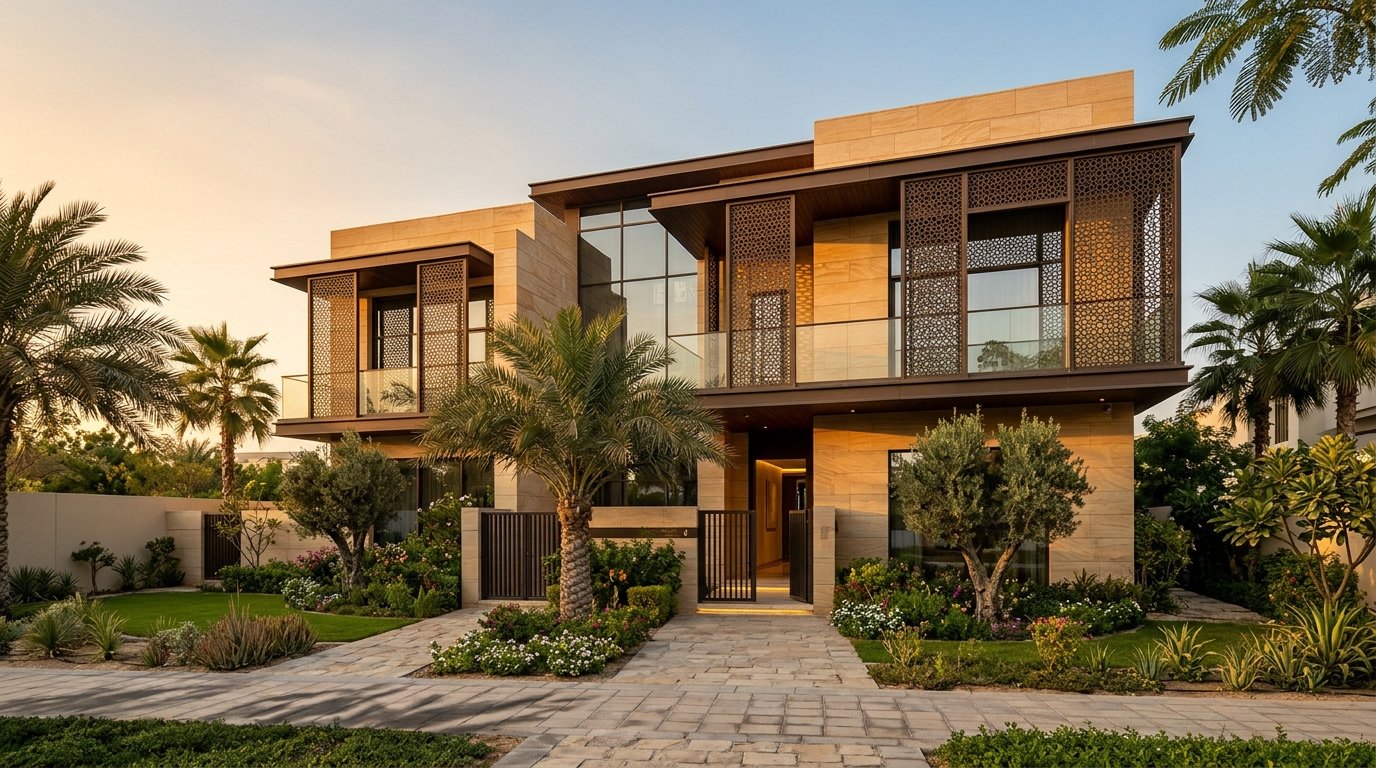
Aluminium or steel mashrabiya panels shade windows and balconies, reduce solar heat and add identity to residential and commercial buildings, while boundary-wall infill panels and gates give villas privacy.
How Do You Make Outdoor Mashrabiya Last in Sharjah?
Outdoor mashrabiya in Sharjah should be made from aluminium, stainless steel or properly coated mild steel rather than MDF or untreated wood. Strong sun, heat, humidity and coastal air quickly damage materials that are not designed for exterior use.
- Use aluminium or grade 316 stainless steel near the coast.
- Specify outdoor-grade powder coating with UV-stable colours.
- Design bar widths strong enough for wind loads on facades and balconies.
- Use stainless steel fixings to avoid rust stains.
- Rinse panels periodically to remove dust and salt.
How Much Does Mashrabiya Cutting Cost in Sharjah?
The cost of mashrabiya cutting in Sharjah depends on the material and thickness, the total area, pattern complexity, finish, framing and installation. Painted MDF screens are usually the most economical, while solid wood, metal, gold finishes and backlit panels cost more. Very intricate patterns take longer to cut and finish than simple geometric designs. Sharing the opening sizes, a photo of the space and a reference pattern is the fastest way to get an accurate quotation.
How to Plan a Mashrabiya Project
- Measure the openings or walls and decide whether screens are fixed, sliding, hinged or freestanding.
- Choose the purpose: privacy, shading, decoration or lighting, as this affects pattern density.
- Select the material based on indoor or outdoor use and budget.
- Pick a pattern and finish that match the interior or facade style.
- Approve a drawing showing sizes, frames and fixing details before cutting.
- Coordinate installation with lighting, joinery and fit-out works.
Mashrabiya Cutting by Faisal Javed Group
Faisal Javed Group of Companies designs and produces mashrabiya screens, partitions, window panels, ceilings, doors, gates and facade panels in MDF, wood, acrylic, aluminium and steel. Every project is drawn to size, CNC-cut in our Sharjah workshop, finished and installed by our team.
- Traditional, modern and custom mashrabiya patterns
- Indoor screens and outdoor-grade metal panels
- Painting, staining, powder coating and LED backlighting
- Installation across Sharjah, Dubai and the UAE
Learn more about our CNC cutting services in Sharjah, CNC metal decor in Sharjah and CNC wood carving, or see our Arabic CNC décor panels.
Book a Free Mashrabiya Consultation in Sharjah
Planning a screen, partition, ceiling or facade? Book a free consultation or send your measurements and a photo on WhatsApp, and our Sharjah team will suggest patterns, materials and a quotation.
Contact Faisal Javed Group of Companies
WhatsApp / Call: +971 55 527 1726
Email: info@faisaljaved.ae
Website: faisaljaved.ae
Location: Industrial Area, Sharjah, UAE — serving Dubai and across the UAE
Frequently Asked Questions About Mashrabiya Cutting in Sharjah
What is mashrabiya?
Mashrabiya is a decorative lattice screen of repeating geometric or arabesque openings used in Arabic and Islamic architecture. It filters sunlight, allows airflow and provides privacy on windows, balconies and interior partitions.
Where can I get mashrabiya cutting in Sharjah?
Faisal Javed Group of Companies designs, CNC-cuts, finishes and installs custom mashrabiya screens, partitions, ceilings and facade panels from its workshop in Industrial Area, Sharjah, serving clients across the UAE.
Which material is best for mashrabiya screens?
MDF is best for painted indoor screens, solid wood and veneered plywood for a natural premium look, acrylic for modern or backlit designs, and aluminium or powder-coated steel for outdoor screens and facades.
Can mashrabiya be used outdoors in the UAE?
Yes, if it is made from aluminium, stainless steel or properly powder-coated steel with UV-stable finishes. MDF and untreated wood are not suitable for outdoor use in the UAE climate.
How much does mashrabiya cutting cost in Sharjah?
Cost depends on material and thickness, total area, pattern complexity, finish, framing and installation. Painted MDF is usually the most economical, while solid wood, metal and backlit panels cost more.
Can you make a custom mashrabiya pattern?
Yes. Mashrabiya patterns can be customised around traditional stars, arabesques, modern geometry, calligraphy, a family crest or a company logo, and scaled to fit any opening.